
Hostages to fortune?

Welcome to the sixtieth edition of Not In The Script (NITS). First, with apologies to American/global friends here or younger readers anywhere, a “nit” is a silly person, as in “nitwit”.
Not that any of you are silly or in any way bereft in the behaving sensibly department, unlike me, but it just seemed to me to be a cute abbreviation.
Certainly not out of the witless, boneheaded or doltish playbook are a couple of the opinions I’ve seen about a book of short stories I’ve been privileged to be involved with. Like this:
“A beautifully constructed book that takes you through the centuries in the company of fascinating and engaging characters and their stories, written by different excellent writers who know history and love it.”
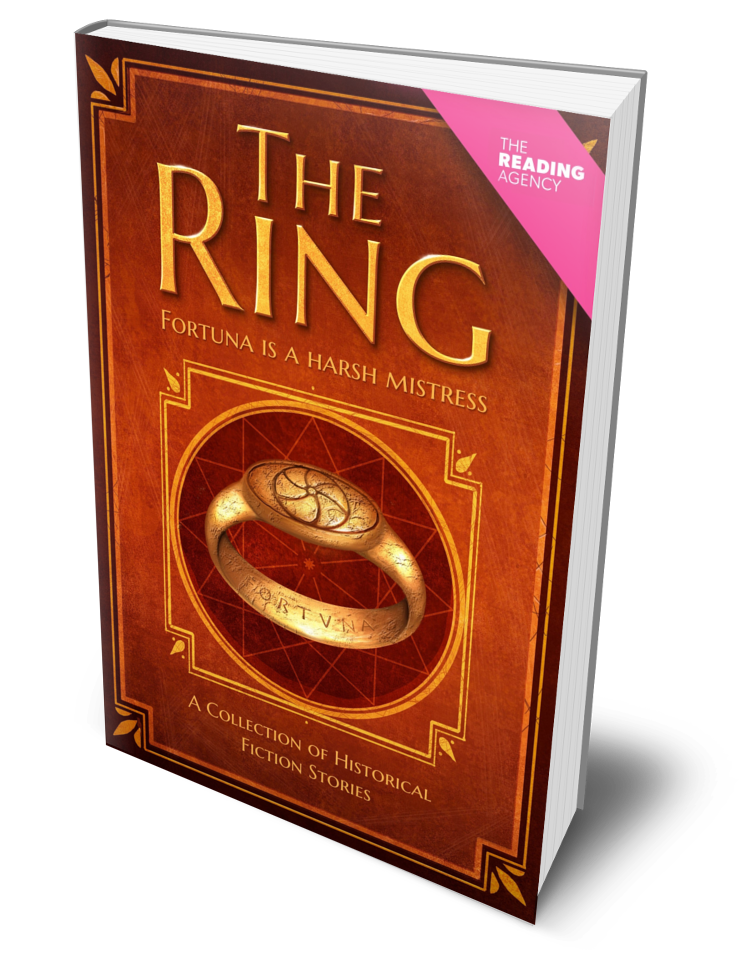
Thus states a five-star review of The Ring, written by 10 historical fiction authors in aid of the charity, The Reading Agency.
As one of those authors, I’m delighted to report that we have made the first two payments (every penny of income) to the Agency which runs programmes to encourage reading for pleasure, helping to build confidence, develop literacy skills, and foster lifelong reading habits.
A worthy cause.
The following Amazon review also caught my attention, reproduced in full so readers can get an objective view of The Ring anthology:
Sometimes Fortune smiles, other times it frowns. And then there are those times where it will only be satisfied with a murder or two. This is the case in the ten stories that comprise The Ring Anthology, all of which focus on a gold ring adorned with a six-sectioned pinwheel in lieu of a gemstone with the word “FORTVNA” engraved inside the band. Each story, told by a different author, passes the ring through time, from the fateful Ides of March of Julius Caesar’s Rome to a hardboiled detective thriller set in present-day New York City. It gradually emerges that the ring smiles favorably upon wearers it deems worthy and turns against those who lose faith in its powers or forsake it—typically in violent or tragic ways. As a motif, the ring provides continuity through the various narrative voices and time periods, heightening interest in discovering how the ring plays its part in each new situation.
Each story leaves an indelible impression as the ring is passed on. Alistair Forrest’s “Wheel of Fortune” exchanges the ring from one assassination victim to another in ancient Rome. Fiona Forsyth continues the Roman theme with a more light-hearted tale, “Ovid Buys a Ring”, involving the famed exiled poet attempting to gift the cursed ring as a present for a newborn. Jacquie Rogers returns to tragedy in a historically based story that takes the ring from Roman-occupied Britain “Home to Palmyra”. From there, the ring emerges on a Mesopotamian battlefield in 530 AD in Alistair Tosh’s “Andreas”. Next up, Graham Brack’s “A Matter of Balance”, set in 1366 England, passes the ring from highborn to low as the result of a freak accident. Eleanor Swift-Hook’s “Fortuna’s Fool” places the ring at the heart of a murderous, yet adventurous, tale involving four of the French king’s Musketeers during the Siege of Nancy in 1633. Mark Turnbull’s “Of Gold and Grief” rescues the ring from a sinking ship off the Azores 19 years later only to lose it again in a desert sandstorm. The ring next appears in 1746 Scotland in a creepy tale by Maggie Richell-Davies that gives a surprise twist to a game of “Hide and Seek”. Robert Bordas takes the ring through immigration across the Atlantic to New York in 1907 in a rags-to-riches story of love and loss called “The Bequest”. Lastly, Val Penny’s “Hunter’s Luck” carries us to the present day with a young Detective Inspector from Britain celebrating his engagement in New York, who ends up on the wrong end of a covetous murder for possession of the ring.
As we reach more modern and less superstitious timeframes, the idea of fate becomes more and more subject to scepticism, as some possessors of the ring discount its magical attributes and put forward more of a belief in personal agency as a bringer of good fortune or bad. Yet there is still room for doubt. As one relatively modern character reflects upon the properties of the ring as his fortune turns from good to bad: “Could it be that Fortune might have played a major role in his life? And when he took it lightly [i.e., by taking off the ring], Fortune turned around and punished him for doing so?”In any case, The Ring Anthology presents a highly satisfying smorgasbord of speculative fiction that engagingly plays with the concept, leaving the reader to wonder: Who knows where the ring will end up next?
If that grabs you, and I hope it does, you can buy the book here, and by doing so will put a few more pennies into The Reading Agency’s deserving coffers.
I loved this book! I thought it was a very clever idea for a collaboration. I also really enjoyed each story and seeing the Fortuna ring go through the centuries.